“ Everything in this issue turns on a substitution. For most of European history, honey was the sweetness that could be had: it sweetened, it preserved, it fermented into mead, and the Church took its wax. Then cane came west with the crusades and settled in the islands, beet was born of a blockade, and honey changed rank. Around that thread stand a drone with no father, stated in 1845 and established only at the turn of the following century; a French harvest that has come in thin again, and what a poor year asks of a cabinet that documents before it buys; and a tree carried from the Appalachians to a Paris garden in 1601, whose honey still travels under a name that is not its own. Four pieces and a word, aiguillon, on what replaces what. ”
— The Conservateur
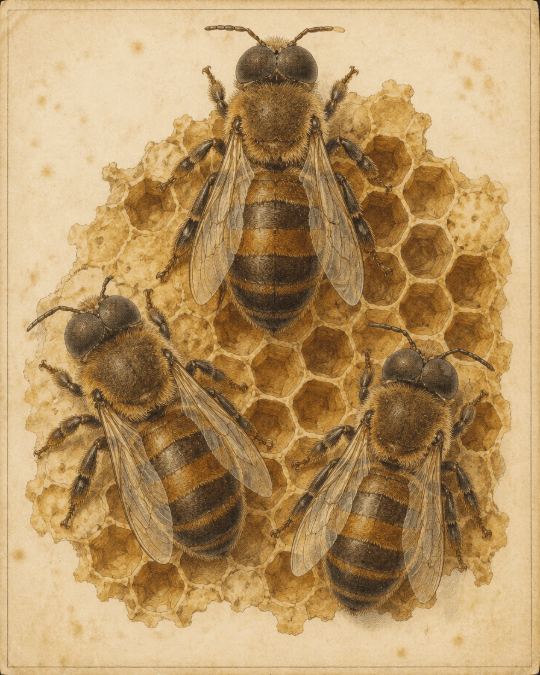
In 1845, Jan Dzierzon, a Silesian parish priest who kept several hundred hives, published the proposition that the drone comes from an unfertilised egg. The male has no father: a mother and a grandfather, and nothing else. The claim offended the received account of generation, and it was disputed for the better part of sixty years.
The cytological work of the turn of the following century found in his favour. Dzierzon died in 1906, at ninety-five, the demonstration acquired. The Cabinet records the date of the statement and the date of the proof, and the distance between them.
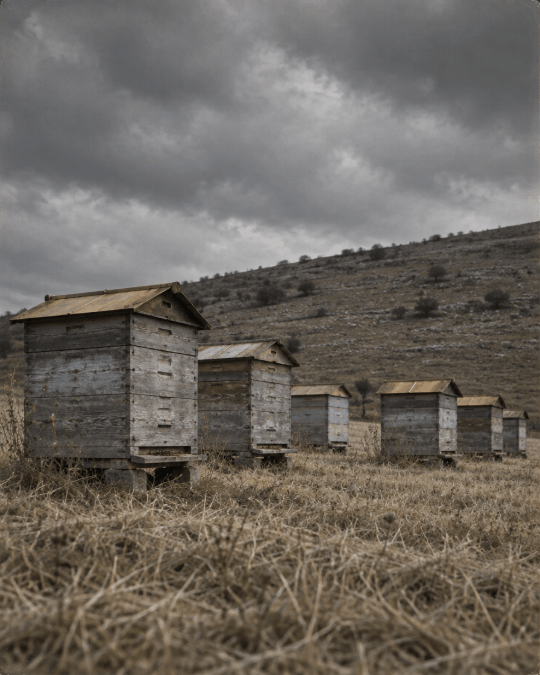
Trade estimates give the French harvest of 2026 as a poor one, a season thwarted in spring, as several of the preceding ones were. Over the long run the order of magnitude is clearer than any single year: a national production counted at around thirty thousand tonnes in the middle of the nineteen-nineties has for a decade moved within a markedly lower band, of the order of ten to twenty thousand tonnes depending on the year and on the source consulted.
For the Cabinet the consequence is plain, and it is a matter of method. When the material grows scarce, the sorting tightens. We document an origin before we retain it, and we would rather enter nothing than enter it wrongly.
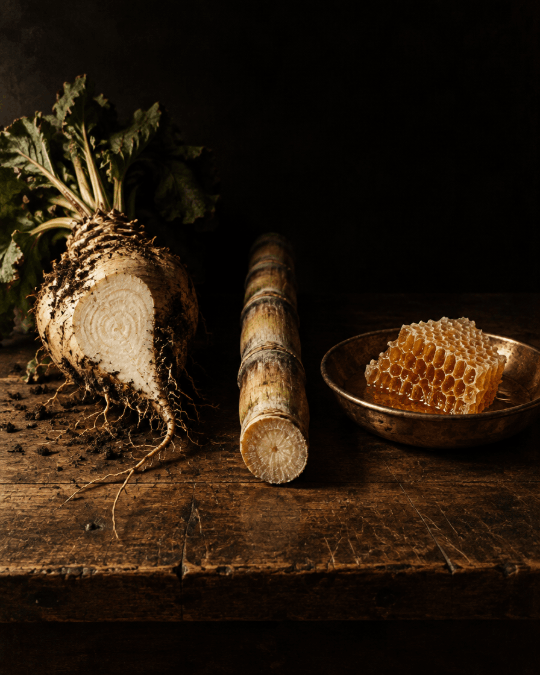
Until the late Middle Ages the sweetness of Europe was honey. It sweetened, it preserved, it fermented into mead, and the wax that came with it lit the altars. Cane sugar, known in the East, arrived with the crusades, then took root in the Atlantic islands and the Americas, where a plantation economy drove its price down century by century.
The second blow came from the continental blockade. Cut off from colonial sugar, France looked inland: in 1812 Benjamin Delessert presented Napoleon with the first loaves drawn from beet, and the Emperor ordered planting. The industry outlived the Empire.
Honey did not disappear. It changed rank. From a food of necessity it became a good of character, bought for what it says of a place. The Cabinet works in that aftermath.
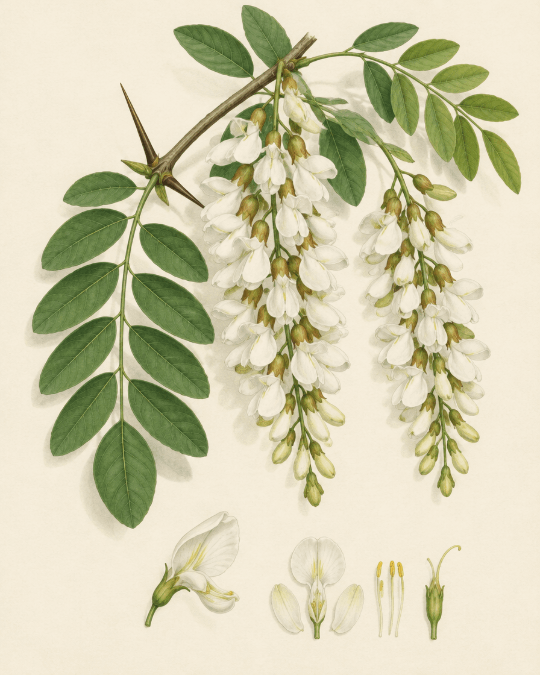
A new serial opens. In 1601 Jean Robin, arborist to the kings of France, received seed of a tree from Virginia and set it in the ground in Paris. The tree took. A specimen planted by him, or by his son Vespasien, still stands in the square René-Viviani, and tradition gives it the date of 1601, which botanists discuss.
A century and a half later Linnaeus named the genus Robinia in the man's memory. The species, Robinia pseudoacacia, carries the misunderstanding in its own name: it is not an acacia, it merely resembles one.
From that American tree planted in a Paris garden came one of the best-selling honeys in Europe, sold under a name that is not its own. The serial will follow the spread, the misnaming, and the market.
It names first the iron point at the end of the drover's staff, the tool that moves the ox; then, by likeness of shape and of effect, the sting of the bee and of the wasp. The word passes from the tool to the weapon without changing its image: a point that compels. In the figurative sense, last, it names whatever drives a man to act. One point herds the beast, defends the hive, and sets a man in motion.
 The Honey Factories