
“Honey is eaten; it may first have been drunk. This issue follows honey into the cup. At Jiahu, on the Yellow River, jars nine thousand years old hold the chemical trace of a drink in which beeswax mingles with rice and fruit. In Ethiopia, most of the harvest of Africa's first producer becomes tej, the country's traditional mead. Between the two, a notice reports the surveys carried out in June at the Lac Bleu, in the Pyrenees, where the relief of a heather country let itself be mapped. The serial follows the mite of Java across its jump of species, and the closing word climbs back to the two roots the Indo-European tongue bequeathed, one for the substance, one for the drink. Three pieces, a serial and a word, to be drunk slowly.”
— The Conservateur
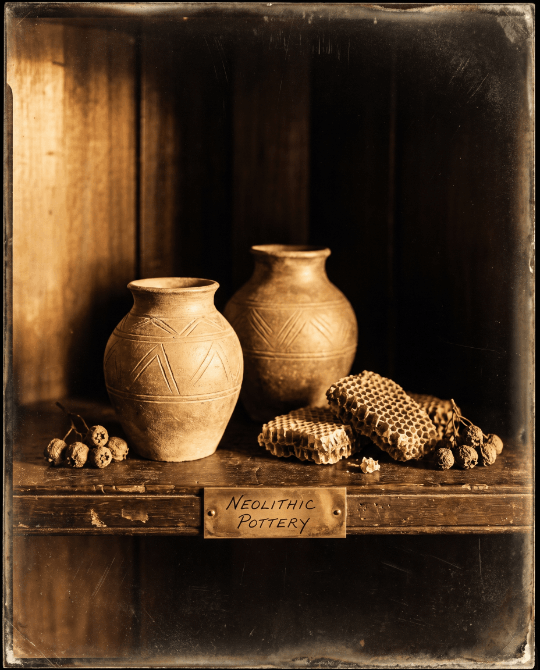
Around 7000 before our era, at Jiahu, in the valley of the Yellow River, in China, Neolithic jars retained in their walls the residues of a fermented drink. The analyses led by Patrick McGovern, of the University of Pennsylvania, identified markers of beeswax there, together with rice and fruit, hawthorn or wild grape.
The mixture fits no modern category: neither beer, nor wine, nor mead in the strict sense, but a hybrid drink in which honey held its part. Published in 2004 in the proceedings of the American academy of sciences, the work stands as the oldest known chemical trace of a fermented drink, honey counting among its sugars.
Mead thus has no birth certificate: it precedes the letter that names it, and no doubt most of the drinks that followed.
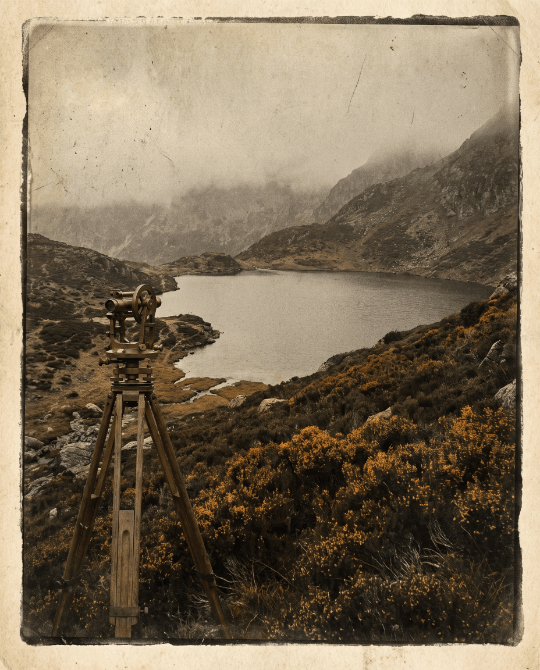
Early in June, terroir mapping studies were carried out at the Lac Bleu, in the Pyrenees, a country of heather. A high-definition LIDAR coverage recorded the relief with a precision new to this ground.
The step belongs to the conservatory's own gesture: documenting the landscape that carries the hive before the honey reveals its memory. The surveys will join the terroir file of the Pyrenean expedition.
Ethiopia is reported to produce some 44,000 tonnes of honey a year, a tonnage that would make it the first producer of the African continent. The figure, drawn from the aggregated statistics of the Food and Agriculture Organisation, varies from year to year and reads as a range rather than an exact value.
Most of that harvest is not eaten: it becomes tej, the country's traditional mead, brewed with the bitter leaves of gesho, a local buckthorn, and served in the berele, a narrow-necked flask. Honey there is a drink before it is a foodstuff.
Long absent from export circuits, Ethiopia obtained access to the European Union market for its honey in 2008. The greater part of the production, however, is still drunk at home.
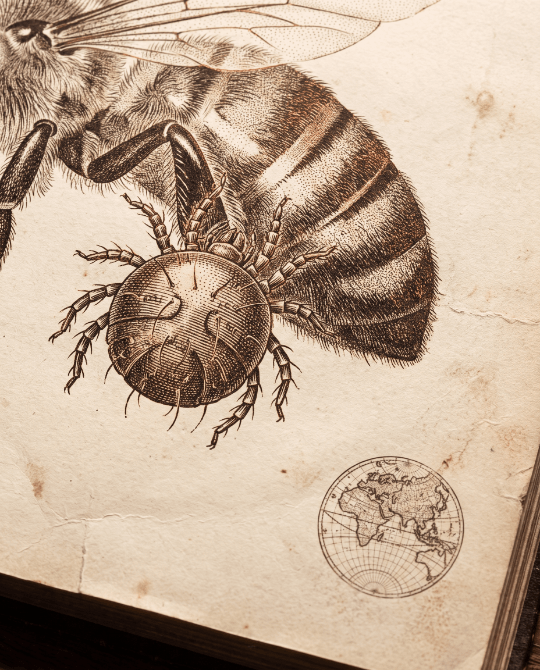
In the middle of the twentieth century, movements of Apis mellifera colonies into Asia brought the European honeybee into contact with the discreet mite of our first episode. On this new host, which nothing had prepared for its presence, the parasite crossed the barrier of species.
The progression ran westward, by stages: eastern Europe in the course of the 1970s, western Europe next, France at the beginning of the 1980s. Apiaries discovered a parasite that the Asian honeybee, for its part, held in check by long-practised mutual grooming.
In 2000, Anderson and Trueman re-examined the mite installed in the world's apiaries and concluded that it was a species distinct from that of Java. They named it Varroa destructor. The next episode will say what that name, chosen without excess, covers.
The Indo-European tongue already parted the substance from the drink drawn out of it. French, which kept no heir of *medhu-, named the drink by a learned compound, hydromel, built on Greek hudôr, water, and meli, honey: the language thus says the drink with the words of the substance, where English keeps for the drink a root of its own. Even the cup, in the end, is named with honey.
 The Honey Factories