
« What is called sovereignty among bees is not decision-making power: it is a reproductive function, wrapped in a courtly vocabulary that men lent to it long after the fact. »
— The Conservateur
In 1609, the English beekeeper and grammarian Charles Butler published The Feminine Monarchie, or a Treatise Concerning Bees. The work broke with a stubborn ancient tradition: since Aristotle and Virgil, the individual ruling the hive had been designated a king. Butler, observing this individual's anatomy and behaviour, explicitly recognised it as a queen.
The book's very title — 'the feminine monarchy' — carries the thesis. Decades would still pass, and Jan Swammerdam's dissections around 1670, before anatomy confirmed what Butler had proposed from observing colony behaviour.
Bulletin ACTA MELLIUM MUNDI now follows a regular weekly rhythm, each Sunday morning. The Cabinet gathers here the fragments assembled over the week — a scholarly fact, a piece of house news, a documented theme, a serial, a word.
This notebook remains open to correspondents and readers wishing to propose a lead worth documenting.
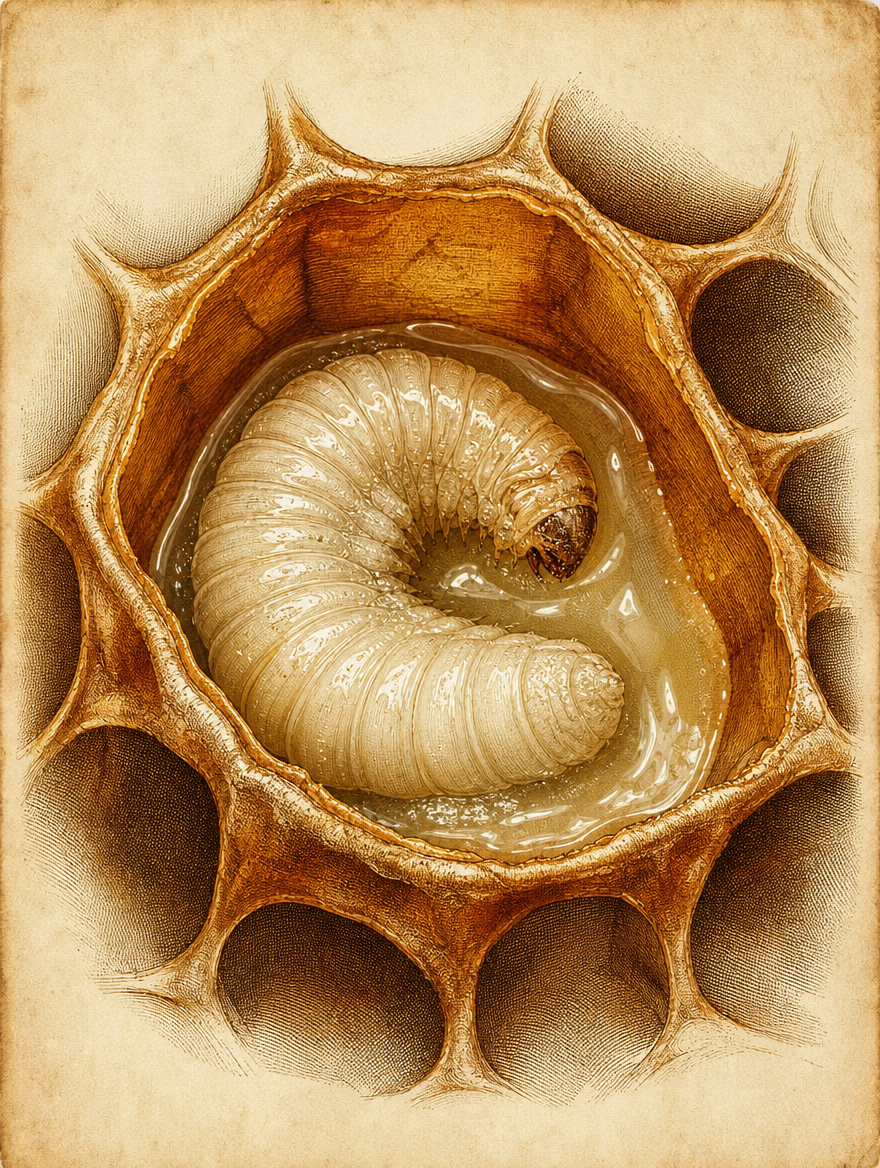
A worker larva and a future queen larva share, at the outset, an identical genome. What separates them is not written in the DNA but on the plate: fed royal jelly continuously throughout development, the larva destined for reproduction becomes a queen; fed a more modest, mixed diet, it becomes a worker.
This dietary determinism operates through mechanisms still only partly understood, involving in particular epigenetic modifications — DNA methylation chief among them — which switch certain genes on or off without altering the sequence itself. One same text, two possible readings, depending on what it is fed.
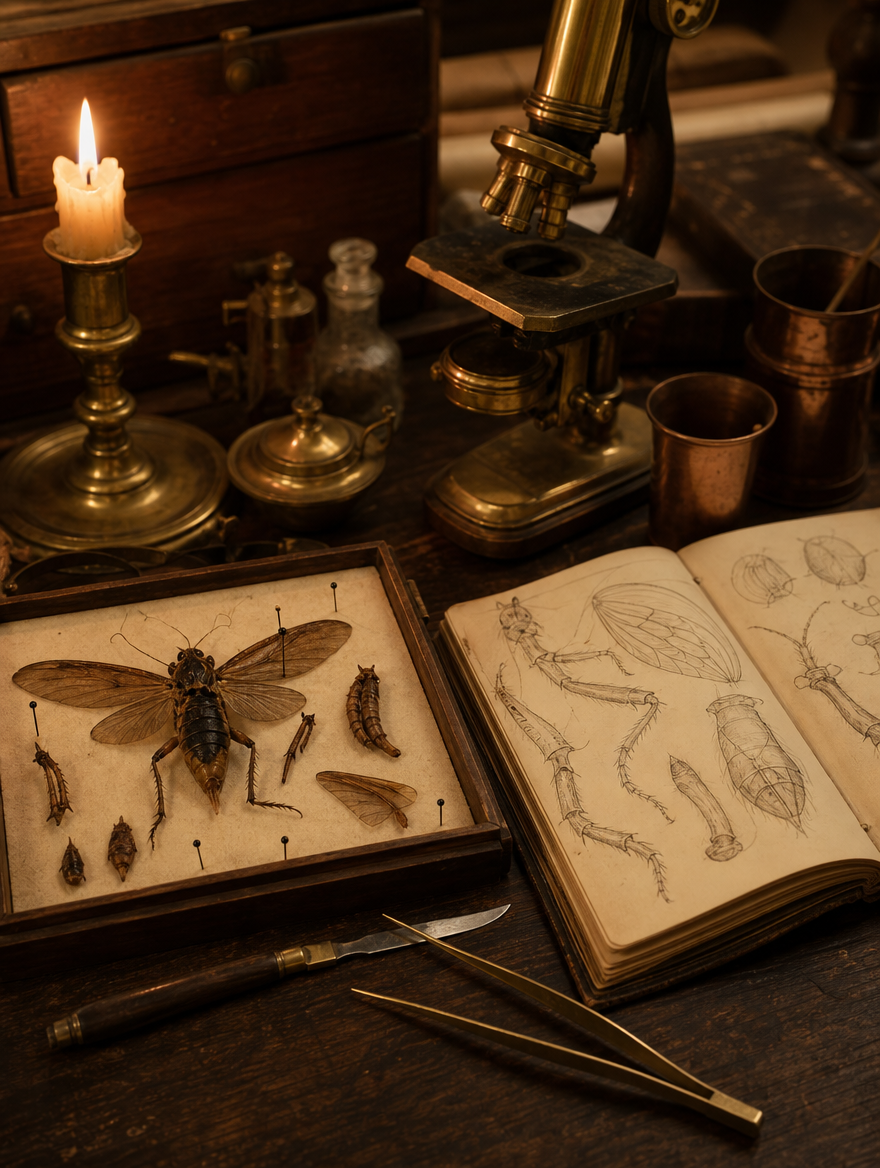
Around 1670, the Dutch naturalist Jan Swammerdam approached the hive with an instrument few of his contemporaries wielded with such precision: the scalpel. Under the lens, he dissected the individual that tradition still called 'king' and found a developed female reproductive system — ovaries.
The observation cut, literally, against centuries of Aristotelian tradition. It converged, six decades on, with the thesis Charles Butler had already advanced from colony behaviour alone. What the eye had sensed, the blade confirmed.
In Greek mythology, the name also designated nurturing nymphs associated with honey, and became a title held by priestesses of certain cults — notably that of Demeter at Eleusis and of Artemis at Ephesus. The botanical genus Melissa (lemon balm, whose essential oil is known to attract swarms) preserves the link directly.
 The Honey Factories