Identity card
- Terroir
- Central Pyrenees · 1,500 to 2,000 m
- Harvest
- late August to mid-September
- Bee
- Apis mellifera mellifera — see CT Anthophila
- Plant
- Calluna vulgaris — see CT Pabula apum
- Extraction
- manual pressing
- Colour
- dark amber, Pfund 80-110
- Viscosity
- thixotropic
- Crystallisation
- slow, fine grain
- Conductivity
- 1.0 to 1.5 mS/cm
Olfactory profile
First nose: dominant floral with medicinal notes (heather in bloom, dry hay, crushed fern).
Second nose: emergence of brown caramel, smoked wood, pine bud, pale leather. Long persistence.
A standard of its own
Heather honey is singular enough that European regulation grants it an exception: the honey directive allows it a higher moisture content than other honeys, up to 23%. Its thixotropy comes from colloidal proteins specific to heather nectar: a gel at rest, fluid under stirring.
From this follows the whole craft: the honey is loosened in the combs with a needle tool before pressing, since centrifuging has no hold on it.
Chemistry of a rebellious honey
Its slowness to crystallise lies in its composition: fructose clearly dominates glucose, and glucose is what crystallises. Its high water content would make another honey ferment; it must therefore be harvested fully ripe and capped. Character, fragrance and caprice: everything about it has a price, which is why it is still pressed.
Gustatory profile
Moderate sweet attack, discreet bitterness, sober acidity. Mid-palate: powerful caramelised development, a resistant texture that yields under agitation (thixotropic effect).
Long, faintly astringent finish, retro-olfaction of burnt wood and rain-soaked moor. Eaten by the spoonful; pairs with hard cheeses and game.
— § —
Sensory note
The only European honey that stands upright in the spoon. At rest it forms a dome and refuses to flow; under agitation it yields, then firms again. The mouth meets the same resistance: a sober attack, a powerful caramelised heart, a long finish of burnt wood and rain-soaked moor. A honey to be chewed as much as tasted.
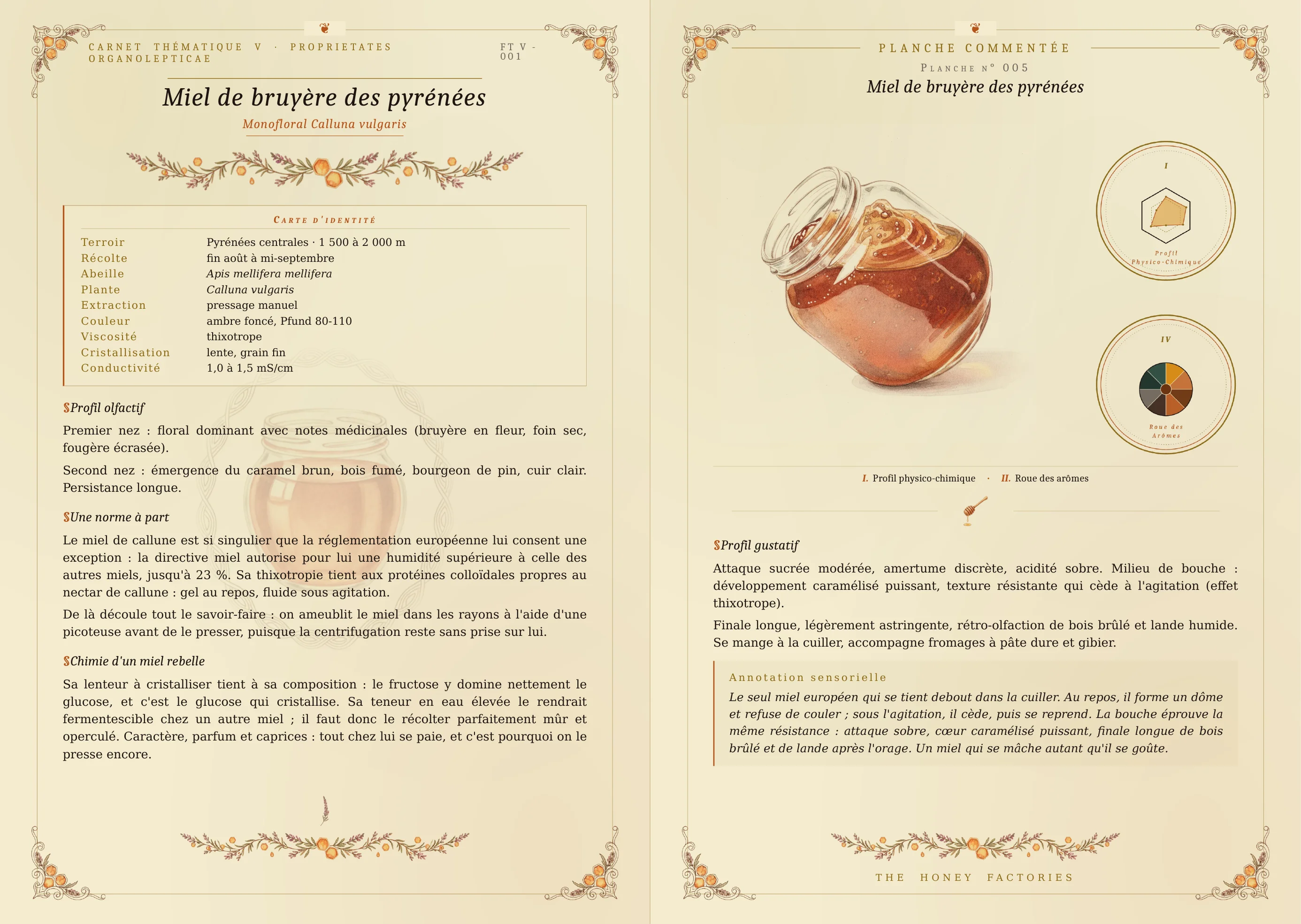
Annotated illustration
Sample in jar · backlit section (1:1)
Clear glass jar in transmission against an ivory ground.
- Coppery amber-brown — Pfund 80-110, visual signature »
- Jar tilted to 45°: the honey does not flow, it forms a dome — thixotropic effect at rest »
Radar diagram · Aromatic families (visualisation)
Polar diagram of 8 axes, scored 0 to 5.
- Dominant: woody (4/5) — brown caramel, smoked wood »
- Secondary: floral (3/5) — heather, fern »
- Tertiary: medicinal (3/5), mineral (2/5) »
Aroma wheel applied (rendering)
Aroma wheel of the honey, descriptors marked by presence.
- Major: heather in bloom · brown caramel · smoked wood »
- Secondary: dry hay · pale leather · pine bud »
- Trace: wet stone · moor after the storm »
Carte d'identité
- Terroir
- Pyrénées centrales · 1 500 à 2 000 m
- Récolte
- fin août à mi-septembre
- Abeille
- Apis mellifera mellifera — voir CT Anthophila
- Plante
- Calluna vulgaris — voir CT Pabula apum
- Extraction
- pressage manuel
- Couleur
- ambre foncé, Pfund 80-110
- Viscosité
- thixotrope
- Cristallisation
- lente, grain fin
- Conductivité
- 1,0 à 1,5 mS/cm
Profil olfactif
Premier nez : floral dominant avec notes médicinales (bruyère en fleur, foin sec, fougère écrasée).
Second nez : émergence du caramel brun, bois fumé, bourgeon de pin, cuir clair. Persistance longue.
Une norme à part
Le miel de callune est si singulier que la réglementation européenne lui consent une exception : la directive miel autorise pour lui une humidité supérieure à celle des autres miels, jusqu'à 23 %. Sa thixotropie tient aux protéines colloïdales propres au nectar de callune : gel au repos, fluide sous agitation.
De là découle tout le savoir-faire : on ameublit le miel dans les rayons à l'aide d'une picoteuse avant de le presser, puisque la centrifugation reste sans prise sur lui.
Chimie d'un miel rebelle
Sa lenteur à cristalliser tient à sa composition : le fructose y domine nettement le glucose, et c'est le glucose qui cristallise. Sa teneur en eau élevée le rendrait fermentescible chez un autre miel ; il faut donc le récolter parfaitement mûr et operculé. Caractère, parfum et caprices : tout chez lui se paie, et c'est pourquoi on le presse encore.
Profil gustatif
Attaque sucrée modérée, amertume discrète, acidité sobre. Milieu de bouche : développement caramélisé puissant, texture résistante qui cède à l'agitation (effet thixotrope).
Finale longue, légèrement astringente, rétro-olfaction de bois brûlé et lande humide. Se mange à la cuiller, accompagne fromages à pâte dure et gibier.
— § —
Annotation sensorielle
Le seul miel européen qui se tient debout dans la cuiller. Au repos, il forme un dôme et refuse de couler ; sous l'agitation, il cède, puis se reprend. La bouche éprouve la même résistance : attaque sobre, cœur caramélisé puissant, finale longue de bois brûlé et de lande après l'orage. Un miel qui se mâche autant qu'il se goûte.
Illustration commentée
Échantillon en flacon · coupe transmission lumière (1:1)
Flacon de verre clair en transmission contre fond ivoire.
- Couleur ambre-brun cuivré — Pfund 80-110, signature visuelle »
- Flacon incliné à 45° : le miel ne s'écoule pas, forme un dôme — effet thixotrope au repos »
Diagramme radar · Familles aromatiques (visualisation)
Diagramme polaire à 8 axes, notation 0 à 5.
- Dominante : boisée (4/5) — caramel brun, bois fumé »
- Secondaire : florale (3/5) — bruyère, fougère »
- Tertiaires : médicinale (3/5), minérale (2/5) »
Roue des arômes appliquée (restitution)
Roue des arômes du miel, descripteurs marqués selon présence.
- Majeurs : bruyère en fleur · caramel brun · bois fumé »
- Secondaires : foin sec · cuir clair · bourgeon de pin »
- Traces : pierre mouillée · lande après l'orage »