
Apis mellifera mellifera
Apis mellifera mellifera
The Black Bee of Western Europe
Identity card
- Family
- Apidae Latreille, 1802
- Species
- Apis mellifera Linnaeus, 1758
- Subspecies
- mellifera Linnaeus, 1758
- Common names
- Black bee · Abeille noire · Dunkle Biene
- Worker size
- 12 to 15 mm
- Proboscis
- 5.7 to 6.4 mm (short corollas)
- Cubital index
- 1.5 to 2.1 (morphometric signature)
- Native range
- north-west Europe, from the Pyrenees to Scandinavia
- Status
- protected at Ouessant (1979), Læsø (1993), Le Boz (2009), Pyrenees (2018)
Morphology
A worker measures 12 to 15 mm, with a near-charcoal coat, short reddish pile. No orange bands on the tergites : an immediate distinction from Italian and Carniolan subspecies. The proboscis is short (5.7 to 6.4 mm), adapted to short corollas. The colony overwinters frugally, consuming noticeably less stores than an equivalent carnica.
Three castes coexist in the colony: the queen, single and fertile; the workers, sterile females specialised by age (cleaners, nurses, guards, then foragers); and the drones, males devoted to mating. The worker, on whom we focus here, lives roughly six weeks during the season.
Behaviour
Forages from 10 °C, two to three degrees below the threshold of the southern subspecies. Early-morning activity grants access to brief high-altitude blooms.
Range up to 5 km, marked floral fidelity. Notably defensive temperament. Heightened vigilance against the Asian hornet is reported by beekeepers, though without established experimental demonstration to date.
The figure-eight dance, decoded by von Frisch in 1944, encodes the distance and azimuth of a resource; in the black bee, abdominal tremor adds a signature of caution. The cohesion of the hive rests on a continuous pheromonal dialogue (queen substance, Nasonov gland, marking of visited flowers).
Range & conservation
Original range: north-western Europe, from the Pyrenees to Scandinavia, the historical subspecies of the whole of France. Threatened by hybridisation (carnica, ligustica, Buckfast), by Varroa, and by intensive breeding. Protected on Ouessant, on Læsø, at the Conservatoire de l'Abeille Noire du Boz and the Conservatoire Pyrénéen.
Behavioural note
The only European subspecies able to open the day at 10 °C, under a light still veiled. Where the Italian and the Carniolan wait for the air to warm, the black bee is already out: its dark pile gathers what little sun there is, its low flight hugs the moor in the lee of the wind. That head start of a few hours secures the brief high-altitude blooms no other race reaches in time. A trait of origin: that of the bees which peopled the north after the glaciations, and which made frugality and patience a way of dwelling in the mountains.
Annotated illustration
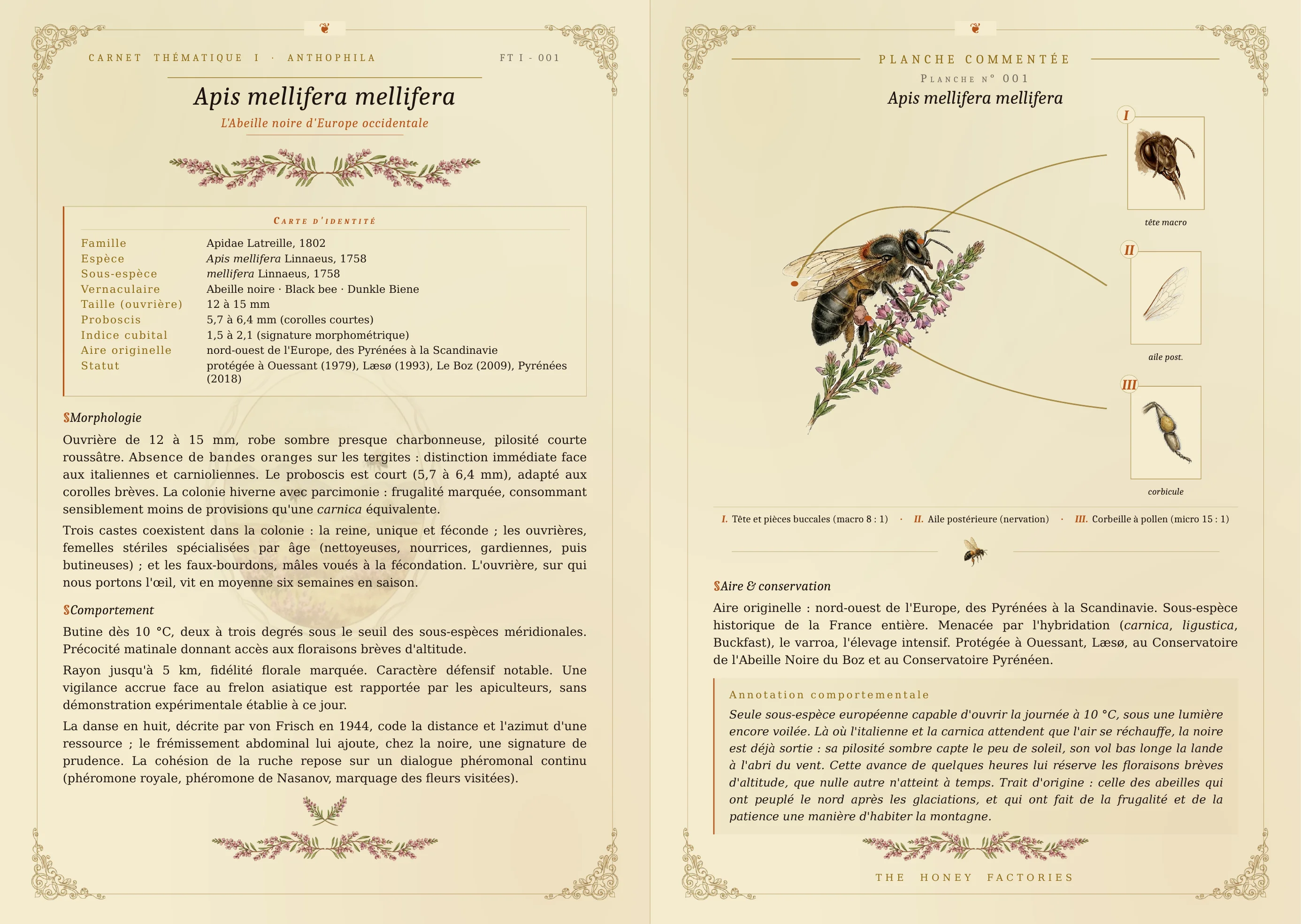
Overall sketch · Worker on heather (1:1)
Forager in profile, wings at rest, corbicula laden with a russet-brown pellet.
- Charcoal coat, short pile — distinctive stocky silhouette »
- Tergites 3 to 6 without pale bands — signature of the subspecies »
- Heather in anthesis — favoured bloom on Pyrenean moorland »
Zoom A · Head and mouthparts (macro 8:1)
Head from the front, elbowed antennae, mandibles ajar, proboscis extended.
- Brown-black compound eye, three dorsal ocelli in a triangle »
- Antennae: short scape, 12-segmented flagellum »
- Short proboscis (5.7-6.4 mm) — signature of short corollas »
Zoom B · Pollen basket (micro 15:1)
Hind leg, corbicula ringed with bristles, russet-brown to dark-purple pellet.
- Corbicula ringed by a crown of bristles — diagnostic of the genus Apis »
- Russet-brown pellet — gathered on heather, signature of the moorlands »