
The Bouhadou of Bigorre
Le Bouhadou de Bigorre
Traditional coiled-straw hive, rendered
Identity card
- Category
- traditional fixed-comb hive
- Range
- Bigorre · Pyrenean foothills
- Etymology
- Gascon "bouhadou", from bouhar (to blow)
- Material
- rye straw, plant binding
- Shelter
- corbelled slate canopy
- Harvest
- single, autumn
- Dating
- attested in the Middle Ages
- Status
- vanished in the 20th century
Context & use
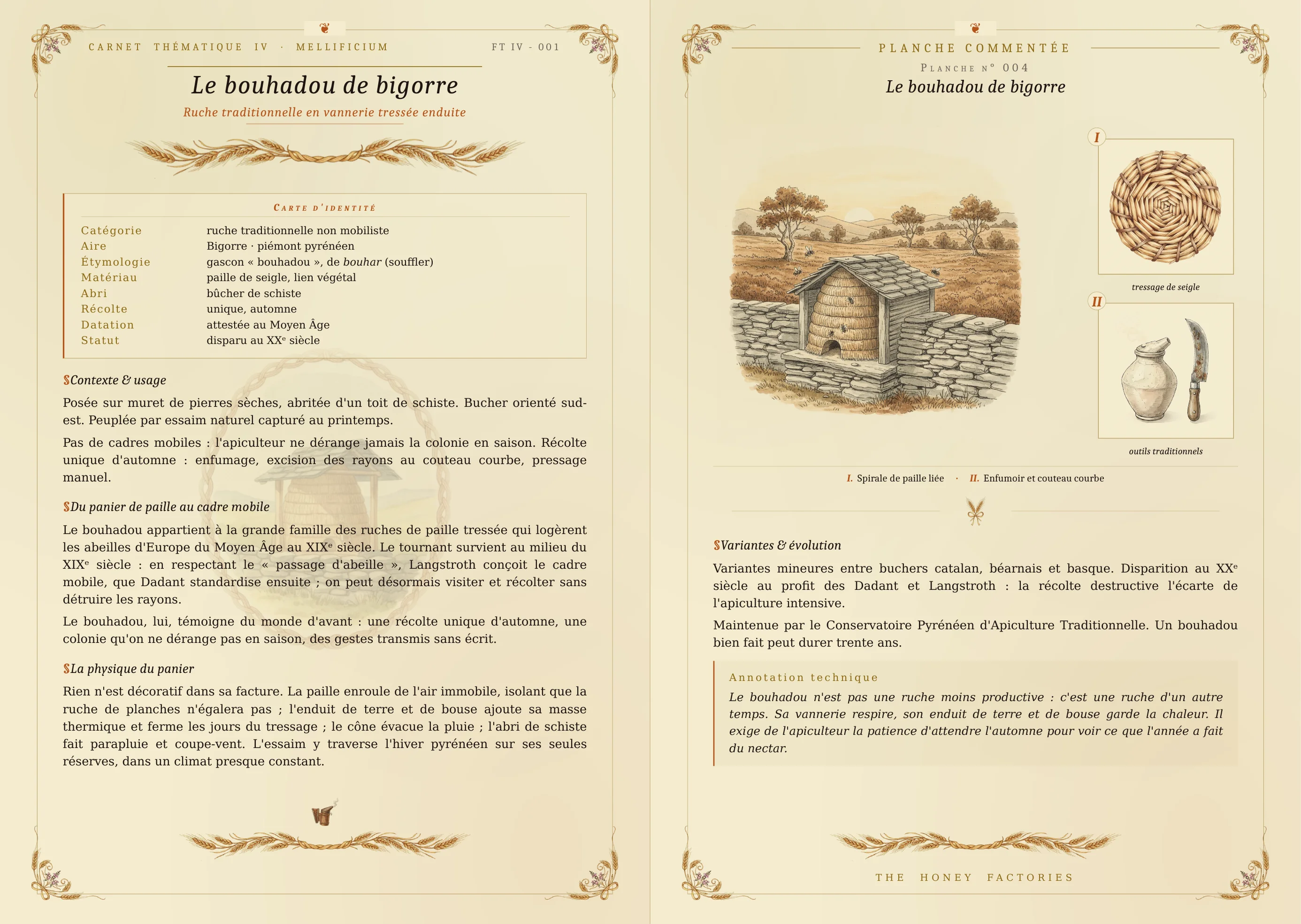
Set on a dry-stone wall, sheltered by a slate roof. Apiary oriented to the south-east. Populated by a wild swarm caught in spring.
No movable frames: the beekeeper never disturbs the colony in season. A single autumn harvest : smoking, excision of the combs with a curved knife, manual pressing.
From straw basket to movable frame
The bouhadou belongs to the great family of coiled-straw hives that housed Europe's bees from the Middle Ages to the 19th century. The turning point came in the mid-19th century: by respecting the "bee space", Langstroth devised the movable frame, later standardised by Dadant; hives could now be inspected and harvested without destroying the combs.
The bouhadou bears witness to the world before: a single autumn harvest, a colony left undisturbed in season, gestures handed down without writing.
The physics of the basket
Nothing in its making is ornamental. Coiled straw traps still air, an insulation no plank hive will match; the earth-and-dung render adds thermal mass and seals the gaps of the weave; the cone sheds the rain; the slate canopy is umbrella and windbreak at once. On its own stores, the swarm crosses the Pyrenean winter in an almost constant climate.
Variants & evolution
Minor variants between the Catalan, Béarnais and Basque apiaries. Disappeared in the 20th century in favour of the Dadant and Langstroth : destructive harvesting made it incompatible with intensive beekeeping.
Kept alive by the Conservatoire Pyrénéen d'Apiculture Traditionnelle. A well-made bouhadou can last thirty years.
Technical note
The bouhadou is not a less productive hive: it is a hive of another age. Its wickerwork breathes, its rendered crown holds the warmth. It asks of the beekeeper what modern beekeeping no longer asks : the patience to wait for autumn to see what the year has made of the nectar.
Annotated illustration
Overall sketch · Bouhadou in a slate apiary (1:1)
Bouhadou coiled on a dry-stone wall, rendered with earth and dung, slate shelter.
- Rye-straw plait in a spiral, bound with debarked bramble »
- Render of straw, earth and dried dung — thermal mass »
- Corbelled slate shelter — protection from the weather »
Zoom A · Cross-section (macro)
Section of a wall portion, the coil and the plant binding.
- Coil roll of 4-5 cm — insulating mass »
- Withy or bramble binding — always plant, never metal »
- Wax combs perpendicular to the flight hole »
Zoom B · Autumn harvest (contextual)
Beekeeper smoking the base, curved knife, honeyed combs.
- Traditional smoker — cool smoke that does not traumatise the colony »
- Excision of the combs with a curved knife — an inherited gesture »
See also: Apis mellifera mellifera, the Black Bee historically housed in the bouhadou →