“Nothing in this notebook remains where it was born. The wax of the wild hives of the Neolithic reappears, nearly nine thousand years later, in the walls of the vessels that carried it across Europe; some three hundred golden bees pass from the tomb of Childeric to the coronation mantle of Napoleon; a mite from Java goes round the world within a human generation. The House, at its own scale, follows the same movement: the Specimen case leaves the drawing to enter the image. Three pieces, a serial and a word, pollen, each an account of how things spread.”
— The Conservateur
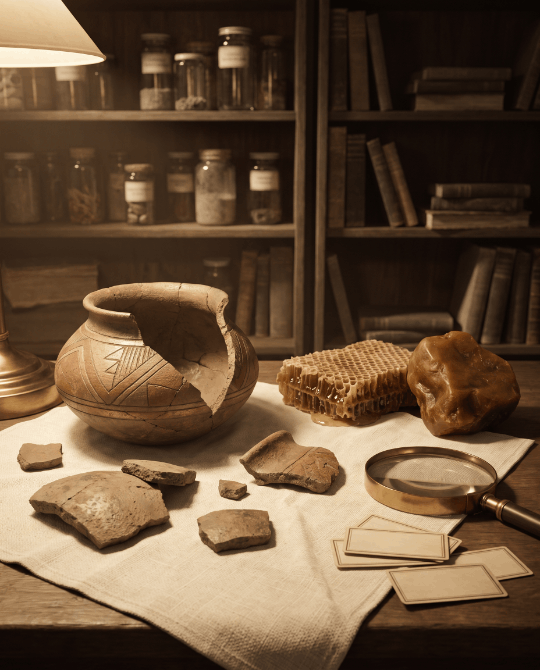
In 2015, a team led by Mélanie Roffet-Salque published in Nature the analysis of lipid residues from more than 6,000 Neolithic potsherds, gathered from Anatolia to the North Sea. Among the expected animal and plant fats, one signal kept returning: that of beeswax, whose alkanes and esters pass through millennia almost unaltered in fired clay.
The oldest traces date from the seventh millennium before our era, in Anatolia, at Çatalhöyük among other sites; they then appear in the Balkans, in Central Europe, and on to the margins of Northern Europe, keeping pace with the spread of agriculture itself. Beyond roughly the 57th parallel the signal falls silent: the honeybee, it seems, went no further north.
What these vessels record is a relation already old and already widespread: from the first farming times, honey or wax was taken from wild colonies, for the table, for waterproofing pottery, or for uses the clay does not tell. Several millennia before any documented hive, the bee was already travelling the roads of men.
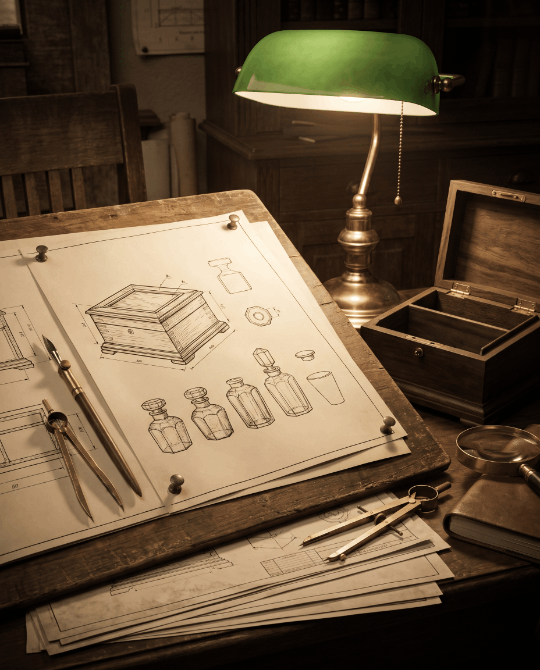
The plans for the Specimen case are settled: the coffer, the flaconnage and the hardware each now have their drawing, their dimensions and their materials. The file therefore leaves the drafting table for the image; the task at hand is to give the volumes their light, their shadows and their grain, so as to see the object before it exists.
This rendering phase precedes any making; it serves to test the drawing, not to display it. The Cabinet will show these images in due course, once they state faithfully what the hands will then have to execute.
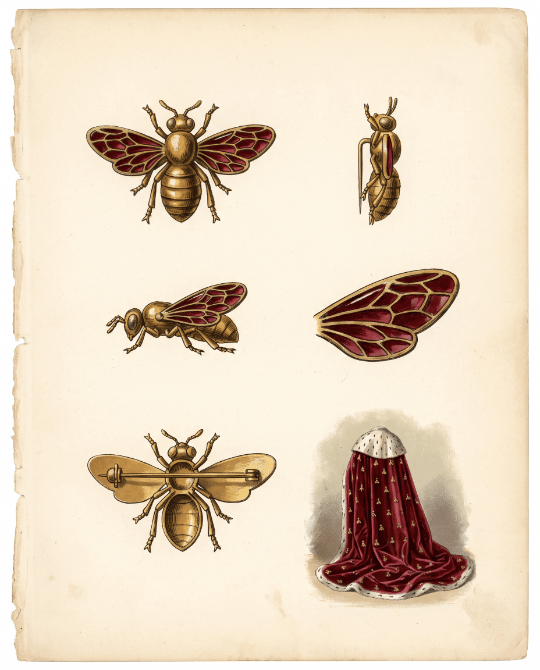
In May 1653, at Tournai, building works uncovered the tomb of Childeric I, king of the Franks, who died around 481. Among the gold of the grave deposit lay some three hundred small bees of gold and cloisonné garnet, by the inventory the physician Jean-Jacques Chifflet gave of them as early as 1655, once sewn, most likely, onto a mantle or a harness. Presented to Louis XIV in 1665, the treasure came to Paris and the Cabinet des médailles.
In 1804, seeking for the Empire an emblem that owed nothing to the Bourbons, Napoleon took up Childeric's bee and preferred it to the lily: golden bees were sown across the coronation mantle and the hangings of the new regime, which thus bound itself to the oldest known king of the Franks.
What followed is darker: in the theft of November 1831 at the Bibliothèque royale, most of the treasure vanished and ended in the melting pot; only two bees were recovered, which the Bibliothèque nationale de France keeps today. From a Merovingian tomb to an imperial mantle, then to a display case, the same sign travelled twelve centuries, changing meaning at every passage.
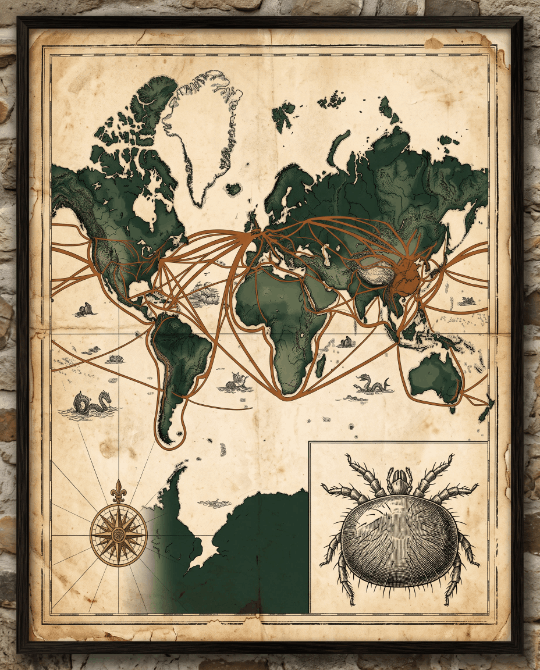
Once the species jump was made, Varroa destructor had only to travel, and man saw to it. Carried by colonies that are moved, traded and shipped, the mite reached European Russia, then Western Europe in the 1970s; France detected it in 1982. No natural barrier stops it, since it travels inside the hive.
The following decades completed the map: the Americas in the 1970s and 1980s, Africa, Asia beyond its cradle, out to distant islands. Within a human generation, a parasite confined to eastern Asia became a planetary companion of the honeybee; even Australia, long spared, reported its first detections in 2022.
Varroa is not a closed chapter: almost everywhere it remains a sanitary constraint of the first rank, and it now sets the rhythm of work in the apiaries. The next episode will enter the hive itself, to watch what the mite does to the colony, and what is attempted to keep it out.
Latin named by this word the finest dust left by milling. The botanists of the eighteenth century, Linnaeus foremost, fixed its use for the fertilising dust of flowers, whose role Camerarius had demonstrated as early as 1694, and it passed unchanged into French and English alike. The sense did not so much shift as change scale: from the millstone to the grain a bee carries. (Sources: TLFi/CNRTL, pollen; OED, pollen, n.)
 The Honey Factories