Identity card
- Period
- 3rd millennium to 4th c. BC
- Civilisation
- Pharaonic Egypt
- Figures
- embalmer-priests, temple physicians
- Hieroglyph
- 𓆤 bjt (bee, Lower Egypt)
- Sources
- Ebers Papyrus (~1550), Edwin Smith (~1600)
- Use
- embalming, remedies, offerings
- Property
- imputrescibility (low water activity)
Attested use
Medicinal: wounds, burns, eye ailments, digestive disorders. The Ebers Papyrus prescribes honey alone or with fats and gums.
Funerary and ritual: the coating of organs, libations on sarcophagi, offerings for the afterlife. A solar substance, golden and incorruptible, the bee bjt appears in the royal titulary.
The pharaoh's bee
The king of Egypt bore the title nsw-bity, "He of the Sedge and the Bee": the bee stood for Lower Egypt, the sedge for Upper Egypt. A late papyrus records the myth that the bee was born from the tears of Ra fallen upon the sand.
Honey went into ointments, dressings and offerings; temple offering lists count it by the jar, alongside bread and beer.
The surgeons' dressing
The Edwin Smith papyrus, a surgical treatise, prescribes for wounds a dressing of grease, honey and lint: the grease protects, the lint drains, and the honey cleanses. Modern chemistry proves the gesture right: low in water and acidic, honey starves germs of moisture and slows their growth. Three thousand years before asepsis, the act was sound.
Posterity
Since 1990, medical research (Molan 1992, Cooper 2014) documents the antibacterial properties of medical-grade honeys : sterilised and standardised products, unrelated to culinary use: low pH, low water activity, endogenous hydrogen peroxide.
The non-perishability of pure honey is real (low water activity): sealed, it keeps for a very long time.
— § —
Mythical & medical note
Born, in myth, of the tears of the solar god, honey was offered to the dead as a portion of eternity. What science now confirms, the antibacterial virtue of pure honey, Egypt had already entrusted to its tombs, four thousand years before the microscope.
Annotated illustration
Fresco detail · Beekeepers of the temple of Niuserre, Abu Ghurab (restitution)
Sepia scene: smoking of clay hives, the pouring of honey, a priest offering an amphora.
- Horizontal clay hives stacked — an Old Kingdom model »
- Smoking by fumigation — a technique unchanged for 4,500 years »
- Priest holding the amphora — a funerary offering »
Zoom · The hieroglyph bjt (macro)
The sign 𓆤 — a bee in profile, wings at rest.
- Bjt means indistinctly bee and honey »
- Inscribed in the royal titulary of Lower Egypt »
The jar and the sarcophagus (evocation)
A sealed jar of honey at the foot of a sarcophagus, an oblique ray of sun.
- A solar, incorruptible substance — a metaphor for eternity »
- A sealed jar — an offering for eternity »
Carte d'identité
- Période
- IIIᵉ millénaire à IVᵉ s. av. J.-C.
- Civilisation
- Égypte pharaonique
- Personnages
- prêtres-embaumeurs, médecins
- Hiéroglyphe
- 𓆤 bjt (abeille, Basse-Égypte)
- Sources
- Papyrus Ebers (~1550), Edwin Smith (~1600)
- Usage
- embaumement, remèdes, offrandes
- Propriété
- imputrescibilité (faible activité de l'eau)
Usage attesté
Médicinal : plaies, brûlures, affections oculaires, troubles digestifs. Le papyrus Ebers prescrit le miel seul ou associé à graisses et gommes.
Funéraire et rituel : enrobage d'organes, libations sur sarcophages, offrandes pour l'au-delà. Substance solaire, dorée, incorruptible, l'abeille bjt figure dans la titulature royale.
L'abeille du pharaon
Le roi d'Égypte portait le titre de nsw-bity, « Celui du Jonc et de l'Abeille » : l'abeille y figure la Basse-Égypte, le jonc la Haute-Égypte. Un papyrus tardif rapporte le mythe selon lequel l'abeille serait née des larmes de Rê tombées sur le sable.
Le miel entrait dans les onguents, les pansements et les offrandes ; les listes d'offrandes des temples le comptent par jarres entières, aux côtés du pain et de la bière.
Le pansement des chirurgiens
Le papyrus Edwin Smith, traité de chirurgie, prescrit sur les plaies un pansement de graisse, de miel et de charpie : la graisse protège, la charpie draine, et le miel assainit. La chimie moderne lui donne raison : pauvre en eau, acide, il prive les germes d'humidité et freine leur croissance. Trois mille ans avant l'asepsie, le geste était juste.
Postérité
Depuis 1990, la recherche médicale (Molan 1992, Cooper 2014) documente les propriétés antibactériennes des miels de qualité médicale : produits stérilisés et normalisés, sans rapport avec l'usage alimentaire : pH bas, faible activité hydrique, peroxyde d'hydrogène endogène.
L'imputrescibilité du miel pur est réelle (faible activité de l'eau) : scellé, il se conserve très longtemps.
— § —
Annotation mythique / médicale
Né, selon les mythes, des larmes du dieu solaire, le miel fut offert aux morts comme une part d'éternité. La science contemporaine confirme le principe : un miel pur, scellé à l'abri de l'humidité, peut traverser les millénaires sans fermenter. Les Égyptiens avaient pressenti ce que la chimie démontre : le miel ne meurt pas.
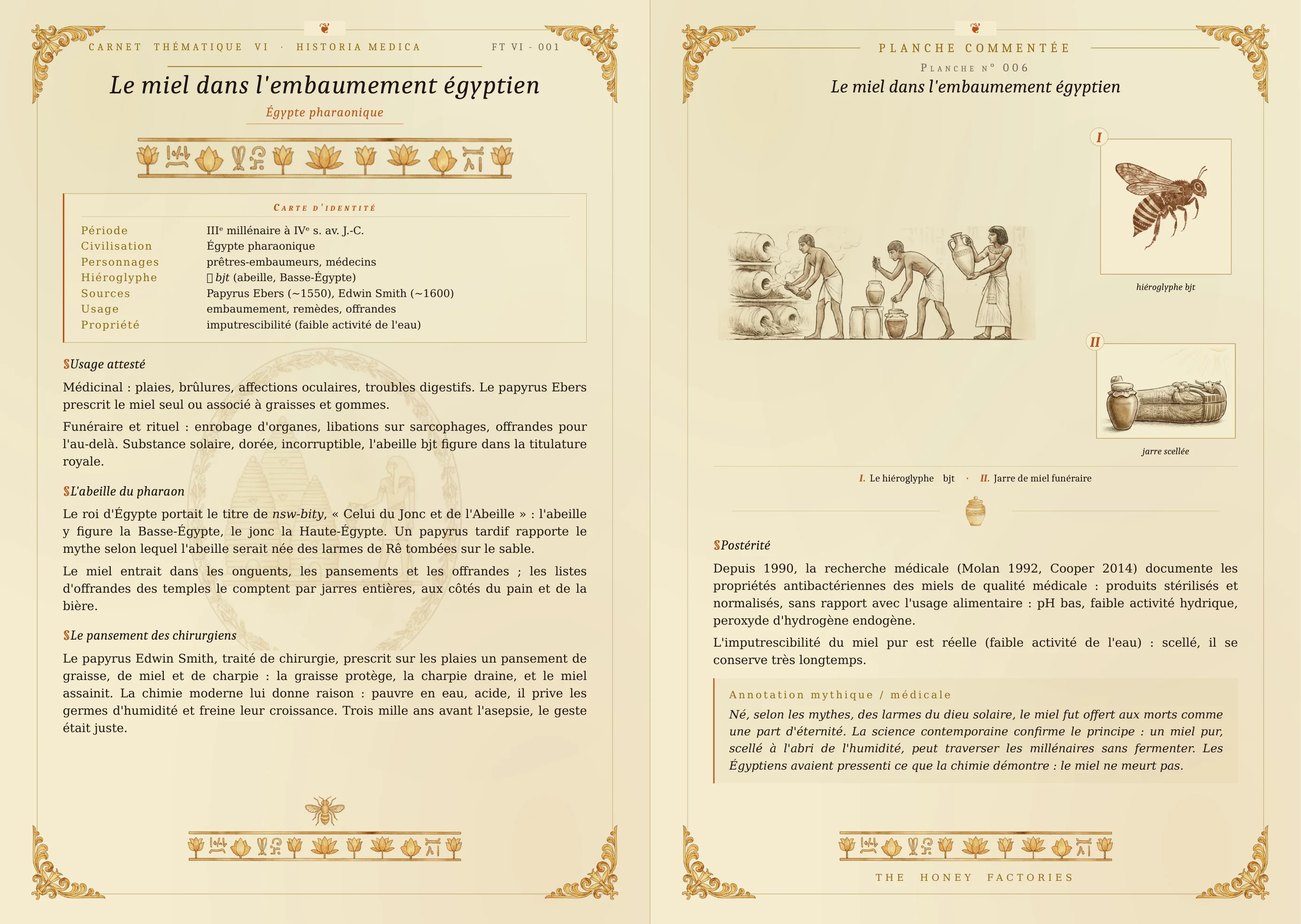
Illustration commentée
Détail de fresque · Apiculteurs du temple de Niouserrê, Abou Ghorab (restitution)
Scène sépia : enfumage des ruches d'argile, coulée du miel, prêtre offrant une amphore.
- Ruches horizontales en argile crue empilées — modèle de l'Ancien Empire »
- Enfumage par fumigation — technique inchangée depuis 4 500 ans »
- Prêtre tenant l'amphore — offrande funéraire »
Zoom · Le hiéroglyphe bjt (macro)
Signe 𓆤 — abeille de profil, ailes au repos.
- Bjt signifie indistinctement abeille et miel »
- Inscrit dans la titulature royale de Basse-Égypte »
La jarre et le sarcophage (évocation)
Jarre de miel scellée au pied d'un sarcophage, rayon de soleil oblique.
- Substance solaire incorruptible — métaphore d'éternité »
- Jarre scellée — denrée d'offrande pour l'éternité »